Home Is The One Place
Their Memory Still Knows.
Home Is The One Place Their Memory Still Knows.
In-home dementia and memory care for families in
Berks, Lehigh, Lancaster & Montgomery Counties, Pennsylvania.
In-home dementia and memory care for families in Berks, Lehigh, Lancaster & Montgomery Counties, Pennsylvania.
Cognitive & Memory Care
No Place Like Home Care provides in-home dementia and memory care for families throughout Berks, Lehigh, Lancaster, and Montgomery Counties, Pennsylvania.
We send trained caregivers directly to your loved one's home, so they never have to leave the environment their brain still recognizes. Their routine stays intact. Their familiar surroundings remain. Their daily life continues, with trained, compassionate support alongside it. Care is nurse-led by Kelly Tyrrell, RN. We serve families supporting loved ones with Alzheimer's disease, vascular dementia, Lewy body dementia, Parkinson's disease, and early-stage cognitive changes.
Private pay and long-term care insurance accepted. VA Aid & Attendance benefits welcome. First 4 hours free for qualifying new clients.
Call or text: (610) 492-6632
You're Trying to Do Right by Someone
Who Is Slowly Becoming Someone Different.
We Understand That Weight.

There is a particular kind of grief that comes with watching a parent, spouse, or loved one navigate memory loss. They are still here. They still laugh at the right moments sometimes. They still reach for your hand. But something is shifting, in the rhythms of their day, in the safety of their home, in how much of the caregiving your family can reasonably carry.
You are probably researching home care because you want them to stay home. You are not wrong to want that. Research published through ScienceDirect confirms that structured in-home care successfully delays long-term nursing home institutionalization. Staying home is not just an emotional preference, for most families in the early-to-middle stages of cognitive decline, it is the clinically supported choice.
The question is how to make it work. That is exactly what No Place Like Home Care is here to help you figure out.
We provide non-medical in-home memory care throughout Berks, Lehigh, Lancaster, and Montgomery Counties. Our care is nurse-led by Kelly Tyrrell, RN, a licensed registered nurse who conducts intake assessments, supervises caregiver placements, and remains available to families throughout the care relationship. Every caregiver placed in a memory care home has completed Learn2Care's specialized dementia training before their first visit.
We don't send a rotation of unfamiliar faces. We send the same caregiver, on the same schedule, building the kind of genuine relationship that makes in-home memory care actually work.
Alzheimer's Care At Home vs. Facility
What Families Need To Know

This is the question most families are trying to answer when they start researching memory care. And it is exactly the right question to ask.
The standard picture of memory care, checking a loved one into a secured residential community, carries a risk most families are never told about. Clinicians call it transfer trauma, or relocation stress syndrome.
When a person with dementia, Alzheimer's, or significant cognitive decline is moved into an unfamiliar environment, the brain's limited remaining ability to orient itself can trigger acute anxiety, agitation, sleeplessness, and behavioral deterioration. The confusion is real and it can be severe. Memory care communities typically require minimum stays of 14 to 30 days specifically because stabilization after the environmental transition takes that long.
This is not a criticism of memory care communities. Many of them do excellent work. It is a fact about what displacement does to a brain that depends on environmental familiarity to function.
In-home memory care eliminates transfer trauma entirely.
When a No Place Like Home Care caregiver arrives, nothing changes about your loved one's environment. Their furniture is where it has always been. The light through their bedroom window is the same. The sounds of their kitchen, the feel of their own chair, the path from the bedroom to the bathroom in the dark, all of it is intact. The brain that struggles to orient in a new facility has no adjustment to make at home. Because nothing moved.
For families in Berks, Lehigh, Lancaster, and Montgomery Counties managing Alzheimer's disease, vascular dementia, Lewy body dementia, or Parkinson's-related cognitive changes, this distinction is often the deciding factor. In the early-to-middle stages of most memory conditions, in-home care preserves quality of life more effectively than facility placement, while allowing families to remain part of their loved one's daily life in a meaningful way.
Is there a stage where facility care becomes the right answer? Yes, and No Place Like Home Care will always tell you honestly when we believe that threshold has been reached for a specific family. That honesty is part of the relationship, not a threat to it.
But for the families who call us every week in Berks, Lehigh, Lancaster, and Montgomery Counties, that threshold is almost always further away than they feared when they first picked up the phone.
What Does In-Home
Memory Care Actually Include?
No Place Like Home Care provides non-medical support for the full rhythm of daily life, tailored specifically to the needs of someone navigating cognitive decline.
What No Place Like Home Care in-home memory care covers:
Personal care assistance, bathing, dressing, grooming, toileting, and hygiene support adapted to your loved one's tolerance and dignity
Meal preparation and clean-up, including texture modifications and hydration monitoring
Structured daily routine management, same sequence, same timing, every shift, the predictability that anchors cognitive function
Verbal medication reminders (caregivers do not administer, pour, or handle medications)
Cognitive engagement activities during peak alertness hours, conversation, reminiscence, music, simple familiar tasks
Behavioral support for agitation, repetitive questioning, and late-day restlessness (sundowning management)
Mobility assistance, fall prevention, and safe transfer support
Light housekeeping immediately surrounding the care recipient
Home safety awareness, monitoring for hazards and environmental changes that signal shifting care needs
Family observation reports, caregivers document behavioral patterns and notable changes at each visit
Wandering safety through active, consistent line-of-sight supervision
What No Place Like Home Care in-home memory care does not include:
Skilled nursing, wound care, injections, clinical assessments, medication administration, physical therapy, or occupational therapy. These services require a licensed medical home health agency. No Place Like Home Care works alongside your loved one's medical team as the daily non-medical support layer, and can help coordinate with clinical providers when skilled services are needed alongside our care.
The Conditions We Support at Home
No Place Like Home Care provides non-medical in-home support for adults living with a range of cognitive and neurological conditions, and for their families.
Alzheimer's Disease
The most common form of dementia. No Place Like Home Care's Alzheimer's care focuses on routine stabilization, environmental familiarity, behavioral redirection, and the kind of consistent caregiver relationship that builds real trust over time. The same caregiver, the same schedule, the same approach, every visit.
Vascular Dementia
Resulting from reduced blood flow to the brain, often following a stroke or series of small strokes. Vascular dementia can progress in steps rather than gradually. No Place Like Home Care caregivers are trained to recognize and respond to shifts in daily function and to support the structured routine that helps stabilize daily life.
Lewy Body Dementia (LBD)
The second most common form of dementia. LBD presents a unique and complex combination of cognitive, physical, and psychiatric symptoms, including visual hallucinations, Parkinson's-like motor changes, sleep disturbances, and dramatic fluctuations in alertness throughout the day. No Place Like Home Care caregivers placed in LBD homes receive specific briefing on hallucination management, fluctuating cognition, REM sleep behavior disorder safety, and the extreme medication sensitivities that make LBD a high-compliance care environment.
⚠️ Important: Individuals with Lewy body dementia have a life-threatening sensitivity to certain antipsychotic medications commonly used in other dementias. No Place Like Home Care caregivers never administer or handle medications. Families should ensure their loved one's medical team is aware of LBD's neuroleptic sensitivity at all times and carry the Lewy Body Dementia Association Medical Alert Wallet Card to every appointment.
Parkinson's Disease and Parkinson's Disease Dementia
Parkinson's disease affects movement, balance, speech, and, in its later stages, cognitive function. No Place Like Home Care provides non-medical Parkinson's support including fall prevention and mobility assistance, transfer support, verbal medication reminders (not administration), freezing of gait response techniques, and ADL assistance adapted to tremor and rigidity. When Parkinson's dementia develops alongside motor symptoms, our care approach integrates both sets of needs. For skilled clinical services (physical therapy, occupational therapy, speech therapy), families should work with a licensed medical home health agency alongside No Place Like Home Care's non-medical support.
Early-Stage Cognitive Changes and Mild Cognitive Impairment (MCI)
Not all memory care begins at a crisis. Many families reach out when they first notice changes, and the right time to introduce professional support is before the need becomes urgent. Starting care in the early or mild stage allows a caregiver relationship to develop naturally, while the care recipient can still participate meaningfully in the process. That relationship is what makes later-stage care possible without severe resistance.
What Level of Care Does Your Loved One Actually Need?
A Practical Staging Guide for Families

One of the most common questions families ask us is not, "Can you help?"
It's "how much help do we actually need right now?"
The honest answer depends on where your loved one is in the progression of their condition. Here is how most families think about it, and when No Place Like Home Care typically recommends starting.
Early Stage (Mild Cognitive Impairment or Mild Dementia)
Most individuals in the early stage can still perform basic daily tasks and live primarily independently. They may need oversight for complex activities, managing medications, tracking appointments, handling finances. Many families begin No Place Like Home Care services at this stage with 4 to 8 hours per week, primarily for companionship, routine reinforcement, and primary caregiver relief.
Starting early is the single best decision a family can make. A caregiver relationship built while the care recipient is still in the mild stage develops naturally, before resistance, before crisis, before the urgency that makes everything harder. Physicians often use the Functional Assessment Staging Test (FAST) or the Global Deterioration Scale (GDS) to classify stage. If your loved one has had a recent assessment, their score can help No Place Like Home Care's nurse-led team calibrate the right starting level of care.
Middle Stage (Moderate Dementia)
This is the most demanding stage for family caregivers, and often the one where they discover they've been carrying more than they should have been for longer than they realized. Mid-stage dementia introduces daily confusion, sundowning, repetitive questioning, safety risks, and behavioral changes that require structured professional support.
Most middle-stage families find that 4 to 8 hours of daily No Place Like Home Care care provides the coverage needed. Hours can scale as needs change, with the same caregiver relationship intact throughout.
Late Stage (Severe Dementia)
Late-stage dementia requires continuous supervision. At this level, the person can no longer safely be left alone for any period due to fall risk, wandering, inability to communicate physical pain, or nutritional and hydration needs that require consistent monitoring.
No Place Like Home Care's live-in and 24-hour care model is designed specifically for this level of need. The flat daily rate structure provides continuous coverage at a transparent, predictable cost, without mandatory facility minimums, admission fees, or medical intake processes.
A note on when home care reaches its limit:
No Place Like Home Care will always tell families honestly when in-home care is no longer the safest option for their specific situation. That assessment is part of our commitment to every family, not a threat to our business relationship with them. If you're unsure where your loved one falls on this spectrum, the best first step is a conversation: (610) 492-6632.
What Is Sundowning?
What No Place Like Home Care Caregivers Do About It.
Sundowning, also called sundown syndrome, is one of the most disruptive daily challenges families face when caring for a loved one with dementia at home. It is not a separate disease. It is a predictable pattern of increased confusion, anxiety, agitation, and restlessness that emerges in the late afternoon or early evening, when diminishing light and accumulated cognitive fatigue converge.
Sundowning can look like: intense pacing, repeated attempts to leave the house, emotional agitation, "shadowing" the caregiver through every room, refusal to cooperate with evening routines, or sudden fear and paranoia. In more advanced presentations it can include visual or auditory experiences that feel completely real to the person experiencing
them.
The important thing families need to know: sundowning behavior is directly connected to wandering behavior. The same neurological disruption that causes sundowning drives the urge to "go home" or leave in the late afternoon, which is why the prevention of one is the prevention of the other.
No Place Like Home Care's sundowning management protocol is built into every memory carecare plan from the first visit:
Demanding activities (bathing, appointments, outings) are scheduled exclusively for morning hours when cognitive reserves are highest
Natural morning sunlight exposure is incorporated into the daily schedule to regulate the biological clock
Bright indoor lighting is increased in the late afternoon before natural light begins to fade, reducing the shadow-created disorientation that triggers sundowning
Caffeine, sugar, and long afternoon naps are strictly limited in the late-day schedule
Evening routines are kept exceptionally predictable, same sequence, same pace, same caregiver, same calm tone, every single day
If your loved one is currently experiencing late-day agitation and your family is managing it alone, call us. We can often begin services within 24 to 72 hours for families in our four-county service area.
Keeping Your Loved One Safe at Home.
What Families Can Do Right Now.
Wandering is a goal-directed behavior, almost always driven by an unmet need. A person who repeatedly tries to leave the house is usually looking for something familiar, trying to escape an overwhelming environment, or responding to physical discomfort like hunger, thirst, or pain. No Place Like Home Care caregivers are trained to identify the underlying trigger, not just redirect the behavior, because addressing the root need is what prevents the next attempt.
Immediate environmental steps families can take today:
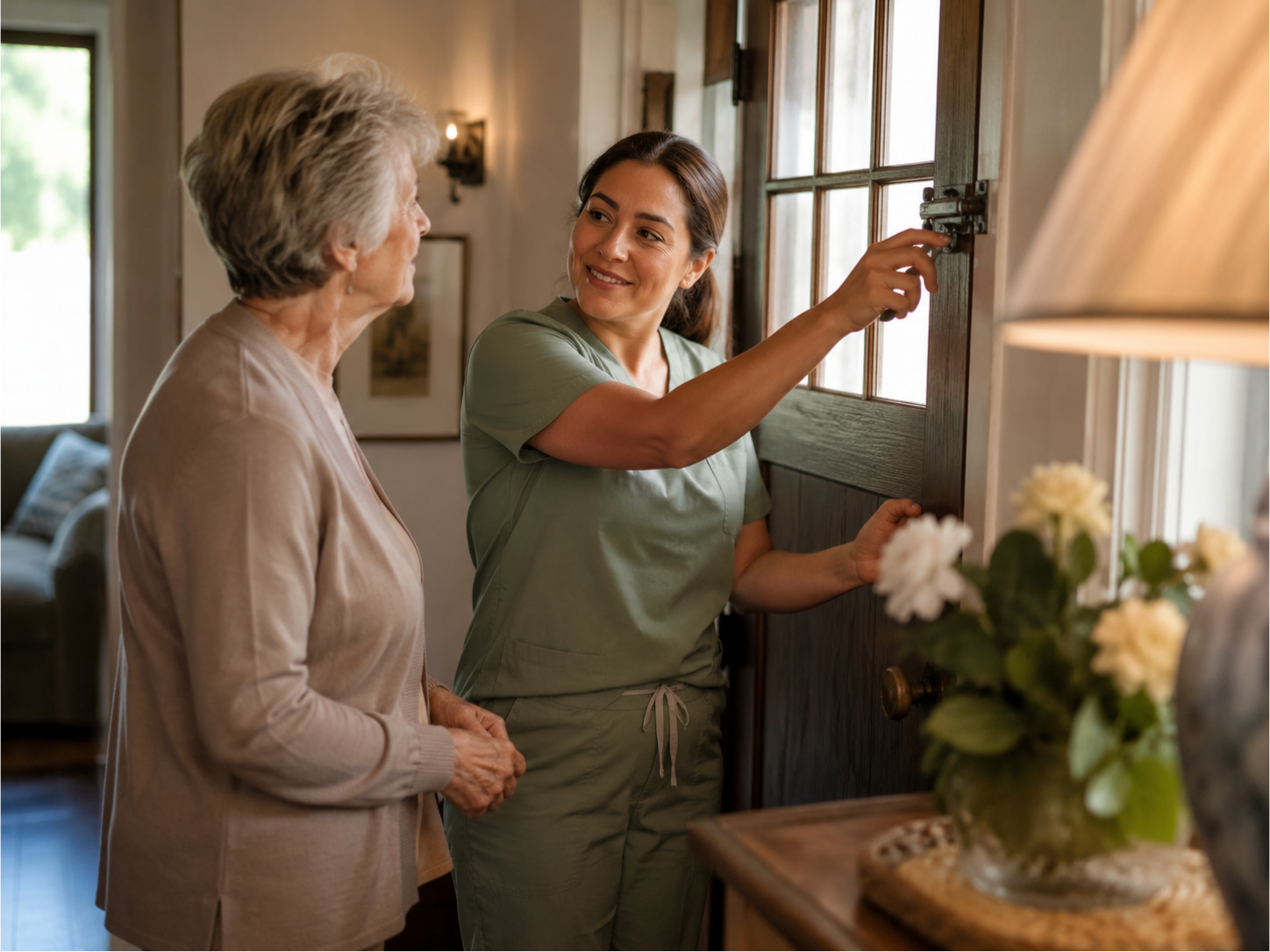
Install deadbolts or slide bolts placed either very high or very low on exterior doors, outside the person's normal line of sight. Place large, dark-colored mats in front of exterior exits. Individuals with advanced dementia frequently perceive these mats as impassable obstacles and will not step onto them. If a door leads somewhere unsafe, disguise it by painting it the same color as the surrounding wall or covering it with a floor-to-ceiling curtain.
Consider registering with the Alzheimer's Association's MedicAlert + Healthy Brain Initiative Safe Return program. If your loved one is ever found wandering, this program connects first responders with your contact information immediately.
If a wandering incident occurs during a No Place Like Home Care shift, our caregivers follow a documented emergency protocol. If your loved one goes missing while in family care: do not wait. Check the immediate property for no more than 10 to 15 minutes. If not found, call 911 immediately. Tell the dispatcher: "I am reporting a vulnerable adult with dementia who has wandered." Request a Silver Alert. Provide a recent photo and a description of their clothing.
No Place Like Home Care's intake assessment includes a wandering-specific home safety review, we identify exit risks and recommend environmental modifications before the first caregiver visit.
"What If They Won't Accept a Stranger?"
How We Build Trust Before We Ask For It.
This is the concern we hear most often before families start memory care. Not the cost. Not the logistics. The question of whether their loved one will accept help from someone they don't know.
Resistance is nearly universal. It almost never means the arrangement won't work. It means the introduction needs to be done right.
No Place Like Home Care uses a structured introduction process we call the Trust Validation Phase for all new memory care clients.
We assign the same caregiver to every visit, not a rotating pool. Consistent caregiver assignment is not a preference for memory care. It is the prerequisite. A rotating cast of unfamiliar faces is destabilizing for anyone with cognitive changes. The same face, on the same schedule, builds a real relationship over time, and that relationship is what makes the care work.
Initial visits are kept short and task-focused. The caregiver arrives as a "home helper" or "kitchen assistant", not as a medical figure. They prepare lunch. They help with light tidying. They're simply present, non-intrusively. Personal care comes later, after trust has been built through less intimate tasks.
The family caregiver stays home for the first one or two visits when possible. The caregiver's presence is normalized while the family member is still in the house, so the introduction happens in the context of safety, not absence.
We introduce the purpose of each visit in terms of tasks, not care needs. "She's here to help with lunch" lands better than "she's here because you need help." This language distinction matters for someone whose awareness of their own condition may be incomplete.
Most families find that after two or three visits, the care recipient is greeting the caregiver at the door.
How Families Pay For
In-Home Dementia Care
Most families who call us assume that in-home memory care is a pure out-of-pocket expense on top of everything else. That assumption is often wrong.
Long-Term Care Insurance (LTCI)
Most modern LTCI policies cover in-home dementia care from a licensed home care agency. The trigger for benefits is typically a physician certification that the policyholder requires assistance with at least two Activities of Daily Living or has a severe cognitive impairment such as Alzheimer's disease. No Place Like Home Care is a licensed Pennsylvania home care agency and can provide the documentation your LTCI carrier requires for reimbursement.
VA Aid & Attendance Benefits
For veterans or surviving spouses receiving Aid & Attendance pension, those monthly tax-free funds apply directly to No Place Like Home Care's in-home memory care, no VA contract required. Veteran families with dementia or Alzheimer's who haven't yet applied for Aid & Attendance should begin the application now. Benefits can be retroactive once approved.
Veterans with dementia often qualify for Aid & Attendance specifically because dementia creates dependency on assistance with Activities of Daily Living, one of the primary eligibility criteria. If your loved one is a veteran living with any form of dementia, this benefit is worth pursuing immediately.
→ See our Veterans & VA Care page for the complete application process.
Medicare GUIDE Model
For families managing an Alzheimer's diagnosis, the Medicare GUIDE model (Guiding an Improved Dementia Experience) may provide up to $2,000 annually in funded respite and support services for qualifying beneficiaries. Ask your loved one's primary care physician about GUIDE model enrollment eligibility.
Pennsylvania Caregiver Support Program
Through your county's Area Agency on Aging, Pennsylvania's Caregiver Support Program provides sliding-scale financial reimbursement for home care and respite services.
Berks County: (610) 478-6500 · Lehigh County: (610) 782-3034
Lancaster County: (717) 299-7979 · Montgomery County: (610) 278-3601
Private Pay
No Place Like Home Care accepts private pay directly. Our hourly rate for memory care begins at $34/hour, and our flat-rate live-in care option, starting at $544/day, provides continuous coverage at a cost that compares favorably to most local memory care facilities.
Note on Medicare & Medicaid:
Traditional Medicare does not cover non-medical in-home memory care, the daily personal care, routine support, and behavioral management that families need most. Medicare covers only short-term, physician-ordered skilled home health services (nursing, therapy). No Place Like Home Care does not accept Medicaid.
Qualifying new clients receive their first 4 hours of care complimentary after completing the intake assessment and placing a payment method on file.
In-Home Memory Care Pricing
Transparent, No Hidden Fees
No Place Like Home Care charges by the hour for in-home memory care. A four-hour minimum applies per visit. A sixteen-hour weekly minimum applies per week. There are no long-term contracts.
HOURLY RATES
─────────────────────────────────────────────────────────
Weekday day shifts - $34/hour
Evening, night & weekend day shifts - $36/hour
Weekend evening/night & holiday shifts - $38/hour
LIVE-IN / 24-HOUR FLAT DAILY RATE
─────────────────────────────────────────────────────────
Weekday - $544/day
Weekend - $576/day
Holiday - $608/day
MINIMUMS
─────────────────────────────────────────────────────────
Per visit - 4 hours
Weekly - 16 hours
ONE-TIME FEE
─────────────────────────────────────────────────────────
Care Coordination & Onboarding - $375
(Non-refundable. Covers nurse-led intake assessment, caregiver matching, and care plan development.)
NEW CLIENT OFFER
─────────────────────────────────────────────────────────
First 4 hours complimentary after assessment and payment method on file.
─────────────────────────────────────────────────────────
Payment: Private pay and LTCI accepted. VA Aid & Attendance accepted as private pay. Medicare and Medicaid not accepted.
How To Start In-Home Memory Care With
No Place Like Home Care
Most families take longer to call than they wish they had. They know something needs to change. They're not quite ready to make it real. Most of them wish, later, that they'd called sooner.
Here's what happens when you do:
Step 1 — The first conversation
Call or text (610) 492-6632 or contact us at noplacelikehomepa.com. We'll talk through your situation, what your loved one is experiencing, what your family is carrying, and what support might actually look like. No pressure. No commitment. No cost to the conversation.
Step 2 — The in-home assessment
Kelly Tyrrell, RN or a member of our care team meets with you and your loved one at home. We assess daily routines, cognitive and physical needs, the home environment, and the family caregiver's situation. We also review home safety and identify any modifications we'd recommend before the first shift. This is where we get the full picture, and where we talk through caregiver matching.
Step 3 — Caregiver matching and scheduling
We identify the right caregiver for your loved one's specific diagnosis, behavioral patterns, personality, and schedule, and confirm the plan with you before the first visit. Memory care matching is more than availability. It is temperament, training, and relationship potential.
Step 4 — Care begins
We can often begin within 24 to 72 hours for families in Berks, Lehigh, Lancaster, and Montgomery Counties. For urgent situations, rapid behavioral deterioration, primary caregiver crisis, imminent safety risk, call us directly.
Qualifying new clients receive their first 4 hours of care complimentary.
Call or text: (610) 492-6632
Email: [email protected]
Frequently Asked Questions About
In-Home Memory Care
What is in-home memory care, and how is it different from a memory care facility?
In-home memory care brings a trained caregiver directly to your loved one's home to provide daily support, personal care, routine management, behavioral support, and cognitive engagement, without your loved one ever leaving the environment they know. A memory care facility is a residential community that requires relocation. For individuals with dementia, that relocation carries the documented risk of transfer trauma, acute anxiety and behavioral deterioration triggered by an unfamiliar environment. No Place Like Home Care's in-home model eliminates that risk entirely.
What is transfer trauma, and why does in-home care matter for dementia?
Transfer trauma, clinically called relocation stress syndrome, is the acute confusion, agitation, and behavioral deterioration that occurs when a person with cognitive decline is moved into an unfamiliar environment. The brain's limited remaining ability to orient itself in a new space can trigger a decline lasting days to weeks. Memory care communities require minimum stays of 14 to 30 days because stabilization after the transition takes that long. In-home memory care eliminates this entirely, your loved one stays in the home their brain already knows how to navigate.
What stage of dementia requires professional home care?
Home care typically becomes necessary during the transition from early to middle stage, when memory gaps, daily confusion, and safety risks emerge that require structured professional support. Many families wait longer than they should. Introducing a No Place Like Home Care caregiver in the early-to-moderate stage allows a genuine relationship to build while the care recipient can still participate in the process. Starting early is consistently less disruptive than starting in crisis. Physicians may use the FAST scale or Global Deterioration Scale to classify stage, either score can help No Place Like Home Care calibrate the right starting level of care.
Does Medicare cover in-home dementia care?
Traditional Medicare does not cover non-medical in-home dementia care, the daily personal care, routine management, behavioral support, and companionship that families need most. Medicare covers only short-term, physician-ordered skilled home health services such as nursing visits or physical therapy. Funding sources that do cover No Place Like Home Care's in-home memory care include long-term care insurance, VA Aid & Attendance pension for eligible veteran families, and private pay. The Medicare GUIDE model may provide up to $2,000 annually for qualifying dementia patients, ask the primary physician about GUIDE enrollment eligibility.
How much does in-home memory care cost per hour?
No Place Like Home Care's in-home memory care rates begin at $34 per hour for weekday day shifts, $36 per hour for evening, night, and weekend day shifts, and $38 per hour for weekend evening, night, and holiday shifts. A four-hour minimum per visit and 16-hour weekly minimum apply. For families needing continuous coverage, our flat-rate live-in care starts at $544 per day, typically competitive with or below local memory care facility rates when all facility costs are included. A one-time Care Coordination and Onboarding Fee of $375 applies. Qualifying new clients receive their first four hours complimentary.
How do in-home caregivers handle sundowning?
Sundowning, the late-afternoon spike in confusion, agitation, and restlessness common in dementia, is managed through environmental and routine adjustments built into every No Place Like Home Care memory care plan. Demanding activities are scheduled for morning hours when cognitive reserves are highest. Indoor lighting is increased in the late afternoon before natural light fades. Evening routines are kept exceptionally predictable, same sequence, same pace, same caregiver, every day. During a sundowning episode, No Place Like Home Care caregivers use validation and calm redirection rather than argument or correction, which amplifies agitation.
How do you handle a loved one who refuses to accept home care?
Resistance to home care is nearly universal and almost never means the arrangement won't work. No Place Like Home Care uses a structured Trust Validation Phase for all new memory care clients. The same caregiver is assigned to every visit. Initial visits are kept short and task-focused, the caregiver arrives as a "home helper" or "kitchen assistant," not a medical figure. They start with hands-off tasks before transitioning to personal care. The family caregiver stays present for the first one or two visits when possible. Most families find that after two or three visits, the care recipient is greeting the caregiver at the door.
Can someone with advanced dementia be safely cared for at home?
Yes, with the right professional support structure. Advanced dementia care at home requires a modified environment, continuous professional caregiver coverage, and a primary family caregiver with external relief. No Place Like Home Care's live-in and 24-hour care model is designed specifically for this level of need. For families reaching the point where in-home care is no longer sufficient, persistent unsafe wandering despite supervision, physical aggression posing serious safety risk, or financial unsustainability of continuous care, No Place Like Home Care will provide an honest assessment and help navigate the transition.
Does No Place Like Home Care provide care for Lewy body dementia?
Yes. Lewy body dementia has distinct care requirements that standard dementia care training does not fully address, particularly its complex psychiatric symptoms (visual hallucinations, fluctuating cognition) and its unique sensitivity to certain antipsychotic medications. No Place Like Home Care caregivers placed in Lewy body homes receive specific pre-placement briefing on hallucination management, fluctuating cognition scheduling, REM Sleep Behavior Disorder safety modifications, and LBD's medication profile. Note: No Place Like Home Care caregivers do not administer medications. Families of LBD loved ones should ensure the LBDA Medical Alert Wallet Card accompanies them to every medical appointment.
How do we get started with in-home memory care?
Call or text No Place Like Home Care at (610) 492-6632 or visit noplacelikehomepa.com. We will discuss your situation, schedule a free in-home assessment with Kelly Tyrrell, RN or a member of our care team, match a caregiver specifically suited to your loved one's diagnosis and personality, and confirm a start date. We can typically begin care within 24 to 72 hours for families in Berks, Lehigh, Lancaster, and Montgomery Counties. Qualifying new clients receive their first four hours complimentary.

Compassionate Care. Right Where You Belong.
Serving families throughout Southeastern Pennsylvania:
© 2026 No Place Like Home Care. | All Rights Reserved. | noplacelikehomepa.com
No Place Like Home Care is a Registered Non-Skilled Home Care Agency licensed by the Pennsylvania Department of Health under License No. HC-93843601.
To report a consumer complaint or concern, contact the PA DOH Home Health Hotline: 1-800-254-5164